Introduction
JETCARP, Jimmie’s Euclidean Tilings and Cellular Automata Research Program, runs cellular automata on almost any tiling of the plane: squares and hexagons, all eleven Archimedean tilings, the 1,248 k-uniform tilings up to k = 6, 81 isohedral tile types, tiles you draw yourself, and the aperiodic Penrose, hat and spectre tilings. It runs Life and the Life-like rules, Generations, Larger than Life, Langton’s ant and the turmites, WireWorld, the cyclic and excitable rules, sandpiles, Lenia and more, several at once if you like, on shared or separate fields. It is one program, with a graphical app, a command line, a scripting language and a Model Context Protocol (MCP) server for AI assistants, and it comes with tools that search for spaceships, oscillators and other patterns and keep verified catalogues of what they find.
This is version 0.4.0, the first public release; the changelog lists what it does, and How JETCARP was made tells where it came from.
Who it is for
- Desktop art. JETCARP can run a scene as a live wallpaper behind your windows, as a screensaver, or as still wallpapers cut to your monitors, in thirty built-in palettes or your own. Start with Your first live wallpaper.
- Hobby exploration. Pick an entry from Quick Start, move it to another tiling, change the rule, draw your own tile, and see what happens. Searching for your own spaceships takes one command. Start with Life on a new tiling.
- Research. Every run is a scene that replays bit for bit and records its state hash; every catalogued pattern has been verified exactly; the searches are resumable jobs whose results do not depend on the thread count and are designed not to depend on the machine; and everything can be scripted. Start with Core ideas and Reproducibility.
A gallery


JACA B27/S013); where the two signs meet, both are
destroyed. Scene docs/scenes/automata/jaca-hat-war.json. Right: James Edmond's
Spectre glider, two gliders crossing a tiling that never
repeats. Scene docs/scenes/automata/priority-spectre-glider.json.

docs/scenes/tilings/ship-57a0326c.json. Right: the
cyclic automaton organising noise into spirals on the hat. Scene
docs/scenes/automata/cyclic-hat.json.
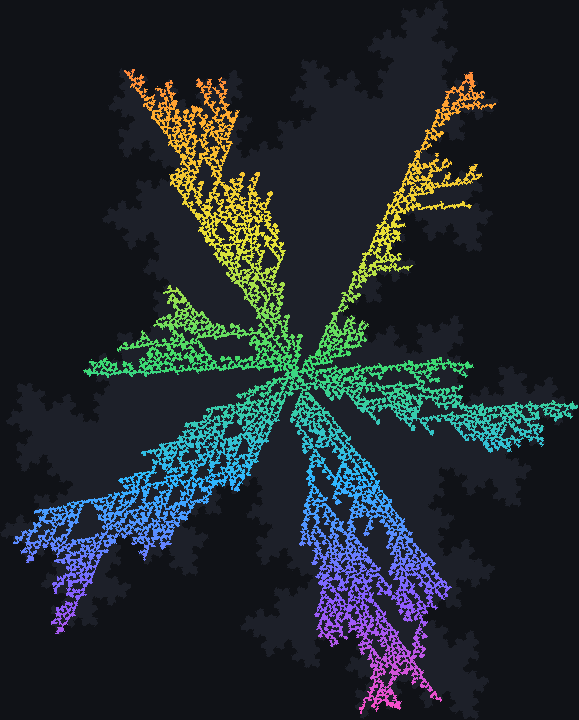
RNL on the trihexagonal
tiling, which builds a highway after about 2,600 steps of disorder. Scene
docs/scenes/automata/turmite-trihex-highway.json. Right: the
layered rule Layer 2/01 grown from one tile of the
spectre tiling. Scene docs/scenes/automata/layered-spectre.json.Every picture in this book is made by JETCARP from the scene named under it, so you can run any of
them yourself: jetcarp run <scene> --gens N --png out.png.
Two ways through this book
- Desktop and hobby. Getting started, then tutorials 1 and 2, then the guides (for example Wallpapers and Searching for patterns) as you need them.
- Research. Getting started and Core ideas, then the encyclopedia of cellular automata and tilings, then Research (reproducibility, search methods, what is new, findings and the bibliography) and the Reference pages.
Standing on earlier work
Almost nothing in JETCARP’s rules and tilings is new: they are the work of many people over seventy years, credited on the page for each family and tiling, in the bibliography, and in Credits. The few things that, as far as we can tell, are new are listed with their evidence in What is new in JETCARP, together with what we decided not to claim. JETCARP was built with heavy use of an AI coding assistant; How JETCARP was made says how, and how its results were checked.
Where to go next
- Install JETCARP and set it up.
- Read the core ideas: tilings, cell fields, rules and scenes.
- See what is new and what the searches found.
- Cite JETCARP if it helps your work, and contribute if you would like to.