How JETCARP generalises automata to any tiling
Almost every well-known cellular automaton was invented on the square grid, and most of their rules are written in terms of that grid: “the eight surrounding cells”, “the cell above”, “turn left”. JETCARP runs these rules on hexagons, pentagons, mixtures of polygons, tiles you draw yourself and aperiodic tilings such as the hat. It can do this because it reduces every tiling to the same object, a neighbour graph, and rewrites each rule family in terms of that graph. This page explains the graph, the choices it involves, and which families could not be carried over.
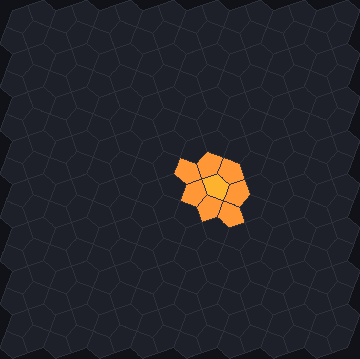
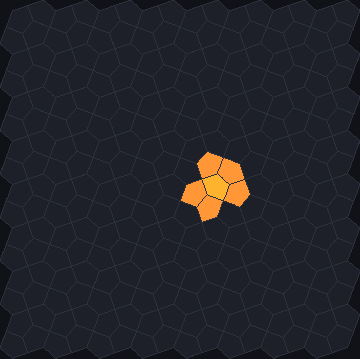
docs/scenes/automata/generalising-touch.json and
generalising-edge.json, 1 generation.What it is
A cellular automaton is a grid of cells, each in one of a few states, updated all at once in steps called generations. Each cell’s next state depends only on its own state and the states of its neighbours. Change what counts as a neighbour and you change the automaton.
On a tiling, the natural neighbours of a tile are the tiles next to it. JETCARP records them as a graph: one node per tile, and a link between two tiles that are neighbours. Everything a rule needs is then a question about the graph: how many neighbours are alive, which neighbour lies to the left, how far away a tile is.
There are two ways for tiles to be “next to” each other, and JETCARP offers both:
- Touch neighbours share an edge or at least one corner. On the square grid this is the eight-cell Moore neighbourhood used by Conway’s Life.
- Edge neighbours share a stretch of edge. On the square grid this is the four-cell von Neumann neighbourhood.
On squares the two give 8 and 4 neighbours. Elsewhere the numbers change, sometimes a lot. A triangle has 12 touch neighbours but only 3 edge neighbours; a Cairo pentagon has 7 and 5; a hexagon has 6 either way, because hexagons never meet at a corner alone. In a tiling with several kinds of tile, the counts differ from tile to tile: in the 4.8.8 tiling a square has 4 neighbours and an octagon 8. On aperiodic tilings they vary irregularly: a Penrose rhomb touches between 7 and 11 others. The tiling catalogue lists the counts for every tiling.
This matters because most rules count neighbours. Life’s rule “born with exactly 3 live neighbours” means something quite different when a cell has 12 neighbours, or when some cells have 4 and others 8. Much of what is interesting about running old rules on new tilings comes from this.
Where it came from
The two square-grid neighbourhoods are named after Edward F. Moore, who described machine models of self-reproduction at a 1961 symposium (Moore 1962), and John von Neumann, whose 29-state automaton used the four edge neighbours (von Neumann 1966; see LifeWiki: Moore neighbourhood and Von Neumann neighbourhood).
Running automata on other grids is almost as old. Marcel Golay used hexagonal cellular logic for image processing (Golay 1969). Carter Bays explored Life-like rules on the triangular tiling (Bays 1994) and on hexagons and pentagons (Bays 2005). Life on Penrose tilings was studied by Hill, Stepney and Wan (2005) and by Owens and Stepney (2010), and Adam Goucher found a glider that travels across a Penrose tiling (Goucher 2012). Ants and turmites have run on triangular and hexagonal grids in Tim Hutton’s Golly rules (Hutton 2015) and on Penrose tilings (ptiles/ant).
General tools came later. Ready, from the GollyGang project, runs user-defined rules on polygonal and polyhedral meshes (Ready). Andrew Trevorrow’s HatLife ran Life-like, Larger than Life-style and WireWorld rules on the hat tiling within weeks of its discovery (Trevorrow 2023), and James Edmond’s work on the hat and spectre runs Generations and priority-table rules on a general graph (Edmond 2026). In October 2026 Trevorrow’s SpectreLife did for the spectre what HatLife did for the hat, with Edmond’s rules (Trevorrow 2026), and bellissimogiorno’s aperiodic-life package runs Life on square, hexagonal and aperiodic tilings (bellissimogiorno 2026). JETCARP builds on all of this.
How JETCARP runs it
One graph, three ways of storing it
Every tiling becomes a neighbour graph in which each tile’s neighbours are kept in clockwise order. How the graph is stored depends on the tiling, but the rules never see the difference:
- Dense storage for lattices of one tile shape (squares, hexagons, bricks), where the neighbours follow a fixed stencil.
- Periodic storage for tilings that repeat a unit cell containing several tiles (the Archimedean, k-uniform and isohedral tilings, and tiles you draw), with one table of neighbour offsets per tile in the cell.
- Explicit storage for finite patches of aperiodic tilings (Penrose, hat and spectre), with every tile’s neighbour list written out.
Periodic worlds can have dead edges (cells beyond the edge count as empty), wrapped edges (a torus), or live edges (cells beyond the edge count as alive). Aperiodic patches have dead edges.
Rules that count
Life-like rules, Generations, JACA, WireWorld and the cyclic, Greenberg–Hastings,
rock-paper-scissors, Hodgepodge and forest-fire families all depend on how many neighbours are in
some state. They carry over directly: a cell counts its neighbours in the graph, whatever their
number. Each automaton in a scene chooses touch or edge; in B/S notation a trailing V means
edge neighbours, as on LifeWiki. Because some tiles have more than nine neighbours, counts of 10 or
more are written with commas: B3,10/S2,3.
The Abelian sandpile is the clearest case of a rule that depends on degree: a tile topples when it holds as many grains as it has neighbours, so on the spectre the threshold differs from tile to tile.
Rules that turn
Langton’s ant and the turmites need direction: “turn right and step forward”. JETCARP
measures turns in slots of a tile’s clockwise list of edge neighbours. R and L turn one slot
either way, U turns half the tile’s degree, and R2 and L2 turn two slots (120 degrees on a
hexagon). After a step the ant faces “straight on”, the slot opposite the edge it came in by. On a
tile with an odd number of sides there is no exact opposite, so “straight on” is rounded and stays
relative to the entry edge. This one convention lets the same ant run on squares, pentagons, mixed
tilings and the hat.
Rules that measure distance
Some families need “within r cells” or “the next row out”. JETCARP uses distance in the graph, counted in steps from neighbour to neighbour:
- Larger than Life counts the cells within
rsteps, over touch neighbours for its Moore form and over edge neighbours for its von Neumann form. On the square grid these are the usual box and diamond. - Layered rules grow outward from a seed tile one layer at a time, where a layer is all the tiles at the same graph distance. This is how JETCARP carries Wolfram’s row-by-row rules to any tiling.
- JACA’s blast radius destroys every cell within
Nsteps of an annihilation. - Lenia is the exception: its smooth kernel uses straight-line distance between tile centres, measured in units of the average tile size.
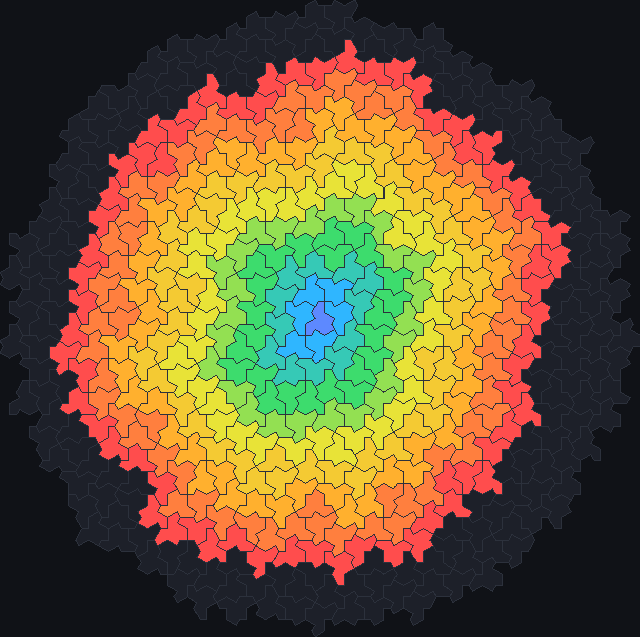
GH 14/1) starts
at one tile and advances one step of the touch neighbour graph per generation, leaving a trail of
refractory states, so each colour band is one distance from the centre. Scene
docs/scenes/automata/generalising-layers.json, 9 generations.What stays on its own grid
A few families are tied to a grid’s geometry in a way that has no natural meaning elsewhere, and JETCARP does not pretend otherwise:
- Elementary rules (
W30) read the three cells above in a square grid; the hexagonal row rules (HexW,HexT) read the hexagons above. Their any-tiling counterpart is the layered family. - Margolus block rules update 2 × 2 blocks of squares on alternating offsets.
- Von Neumann’s 29-state automaton depends on the four compass directions; JETCARP refuses to place it on another tiling.
What is new here
None of the ingredients on this page is new on its own, as the history above shows: Ready runs arbitrary rules on meshes, HatLife, SpectreLife and Edmond’s work run several families on the hat and spectre, and many single families have been run on hexagons, triangles or Penrose tilings. What JETCARP adds, to our knowledge, is breadth: one engine that runs every family listed here on every class of tiling it supports (lattices, the 1,248 k-uniform tilings, 81 isohedral types, drawn tiles, and the Penrose, hat and spectre tilings), with the same neighbour model throughout. Not all of these are different graphs: the 81 isohedral types have only the eleven graphs of the Laves tilings, and several drawn families copy the square or hexagonal grid (see Isohedral tilings). Tests check that results agree across thread counts and, where available, between CPU and GPU.
Our prior-art search found no earlier version of the cyclic, Greenberg–Hastings, rock-paper-scissors, Hodgepodge or forest-fire rules on aperiodic tilings, or of turmites on the hat and spectre. Each of these is a direct application of a known rule to a known graph, though, so we do not count them as discoveries. The search behind these statements is summarised in What is new in JETCARP.
Try it
- In the app, any Quick Start entry can be moved to another tiling: change the tiling and the rule keeps running. The Tiling showcase entries pair each tiling with a rule chosen to stay lively there.
- Run the figures above from their scenes, for example
jetcarp run docs/scenes/automata/generalising-touch.json --gens 1 --png touch.png. jetcarp tilingslists every tiling family with its edge and touch neighbour counts.