Von Neumann’s 29-state automaton
John von Neumann designed this automaton in the early 1950s to answer a question about life itself: can a machine build a copy of itself, including the instructions for building the next copy? Von Neumann’s answer was a universal constructor made of cells, each with 29 states, connected to its four neighbours. Conway’s Life began as a simplification of its ideas. JETCARP runs it on the square grid, from the rule as published.

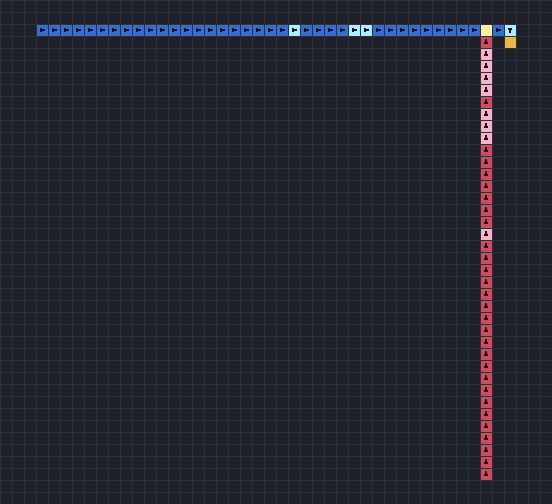
docs/scenes/automata/vonneumann-channels.json.What it is
Every cell is in one of 29 states, and talks only to its four edge neighbours:
- Ground (unexcitable), the empty background.
- Transmission states: ordinary and special, each pointing in one of four directions, each quiescent or carrying a signal (16 states). A transmission cell passes a signal in the direction it points, one cell per step. A signal of the other kind (ordinary versus special) pointed at a transmission or confluent cell destroys it, turning it back to ground.
- Confluent states (4), which combine signals: a confluent cell fires only when all the ordinary cells pointing into it fire, and it delays its output, which lets it act as an AND gate and a memory element.
- Sensitised states (8), the intermediate steps by which a signal arriving at ground builds a new cell. A sequence of signals sent into ground decides, bit by bit, which of the other states the new cell becomes.
With these parts, a constructing arm can extend into empty space, build any pattern of cells by sending the right signal sequences, and withdraw again. Von Neumann’s design couples such an arm to a long tape of instructions; the machine reads the tape, builds a copy of itself, and copies the tape into it: self-reproduction from a description, a constructor and a copier.
docs/scenes/automata/vonneumann-construct.json, 20 generations.Where it came from
Von Neumann’s work on automata began with “The General and Logical Theory of Automata” (1948) and a series of lectures at the University of Illinois in 1949, which described a kinematic self-reproducing machine built from mechanical parts. Arthur W. Burks writes that Stanisław Ulam suggested a cellular framework would be easier to treat mathematically. Von Neumann then designed an infinite array of square cells, each holding the same 29-state automaton. Von Neumann began the manuscript in September 1952 and worked on it until 1953, and left it unfinished (von Neumann 1966).
Burks edited and completed the work as Theory of Self-Reproducing Automata (1966), which states the transition rule and shows how to finish the self-reproducing design (von Neumann 1966). A footnote there notes that Edward F. Moore’s 1962 paper proposed the name “tessellation model” (Moore 1962). E. F. Codd later reduced the number of states to 8 (Codd 1968; see Rule tables).
The first working implementation of a self-reproducing universal constructor was built by Renato Nobili and Umberto Pesavento in 1994; to simplify the design they extended the rule so that confluent cells can cross signals (Pesavento 1995; Nobili and Pesavento 1996). Golly runs the original 29-state rule and the extended Nobili32 and Hutton32 variants (Golly: JvN), and Yinusa and Nehaniv used it to show that the completed machine passes heritable mutations to its offspring (Yinusa and Nehaniv 2011). Greg Turk’s 2025 review traces the line from von Neumann through Codd and Langton to the present (Turk 2025).
How JETCARP runs it
From the book
JETCARP’s JvN29 was written from Burks’s 1966 edition: the states and transition rule (section
2.8.1), its verbal summary (2.8.2) and the worked illustrations (2.8.3). The book’s formal statement
of the rule is garbled in the scanned text that was available, so the implementation follows the
clear verbal summary, which the legible parts of the formal rule agree with. Where the text left
details open, the choices were checked against the book’s own examples:
- A cell is destroyed by a signal of the other kind pointing at it from any side, including head on, so an ordinary and a special signal pointing at each other destroy each other.
- Destruction wins over receiving a signal but not over sending one: a cell excited at one step still delivers its signal at the next, even though it has become ground.
- In the storage loop of Fig. 12 the text says four cells store five bits, which four one-step cells cannot do, so one of them must be a confluent cell (a two-step delay). Starting it that way reproduces the book’s trace exactly.
- The construct-and-withdraw sequence of Fig. 14 builds its path, writes the confluent cell and withdraws in exactly the 37 ticks the book states.
The book is in copyright; only the rule, which is an algorithm, is reimplemented. No code, rule files or patterns from other programs were used. JETCARP numbers the states its own way (ground 0, sensitised 1 to 8, transmission 9 to 24, confluent 25 to 28), so its patterns are not interchangeable with other programs’ files.
Notation and display
The rule is written JvN29 (also JvN or VonNeumann29). The Draw tool lists the states by name.
Ordinary transmission cells are blue and special ones red, excited forms pale and bright; confluent
cells are green and sensitised ones amber. Pictures draw an arrow on each transmission cell when tiles
are at least 10 pixels across.
Square grid only
The rule depends on the four compass directions, so it has no meaning on other tilings, and JETCARP refuses to place it on one or to switch a world containing it to another tiling. Cells beyond a dead edge count as ground; wrapped edges work.
What is new here
Nothing. This is von Neumann’s automaton as Burks published it. JETCARP’s contribution is a fresh, documented reading of the book, with the ambiguities and how they were resolved written down.
Try it
- Quick Start: von Neumann: storage loops growing channels and von Neumann: construct and withdraw.
jetcarp run docs/scenes/automata/vonneumann-construct.json --gens 37 --png construct.pngruns the whole Fig. 14 sequence.