Hexagonal row rules: HexW and HexT
Elementary rules build a picture row by row on the square grid, each cell reading the three cells
above it. On a grid of hexagons the rows are staggered, so a cell sits under two cells, or, if
the hexagons are turned to have flat tops, under three cells at two different heights. JETCARP has
a family for each: HexW with two parents and HexT with three. Both come in binary and
three-state versions.
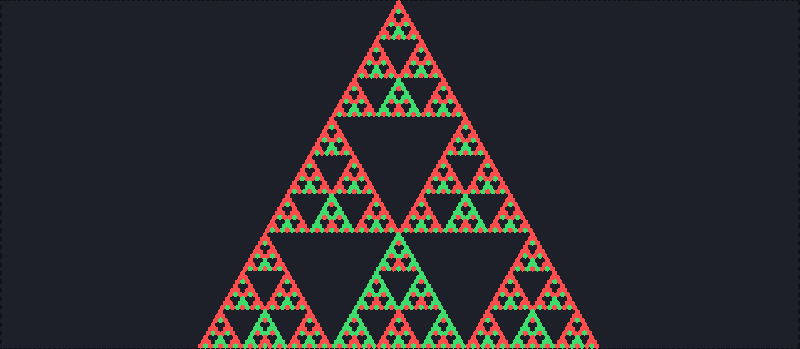
HexW3 8229 from a single cell: each hexagon is the sum, mod 3, of the two
hexagons above it, which draws Pascal's triangle mod 3. Red and green are the two non-zero states.
Scene docs/scenes/automata/hex-hexw3.json, run until the bottom row is written.What it is
Two parents (HexW, HexW3). On a grid of pointy-topped hexagons, each hexagon touches two
hexagons in the row above, one up and to the left, one up and to the right. A two-parent rule gives
the new cell’s state as a function of those two. With two states there are 2 × 2 = 4 parent
patterns and so 24 = 16 rules; with three states there are 9 patterns and
39 = 19,683 rules. HexW 6 is the exclusive or of the two parents, which draws Pascal’s
triangle mod 2 just as rule 90 does on squares.
Three parents (HexT, HexT3). Turn the hexagons a quarter turn so they have flat tops. Now
three hexagons touch a cell’s upper edges: NW and NE, half a row higher, and N, a full row higher.
The grid fills in by height in half-row layers, and each new layer is computed from the two layers
before it. With two states there are 8 parent patterns and 256 rules, numbered like Wolfram’s
elementary rules; with three states there are 27 patterns and 327 (about 7.6 trillion)
rules. Two smaller sets are easier to explore: totalistic rules, which depend only on the sum
NW + N + NE (2,187 three-state rules, 16 binary ones), and left-right symmetric rules, which treat
NW and NE alike.
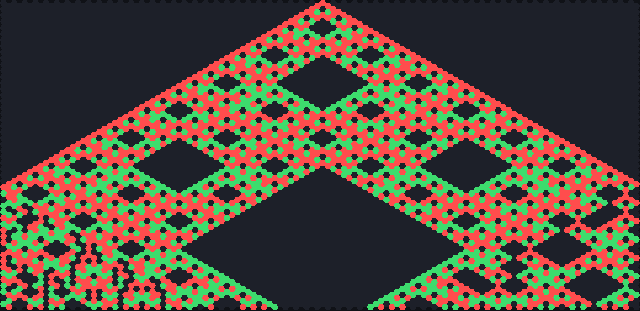
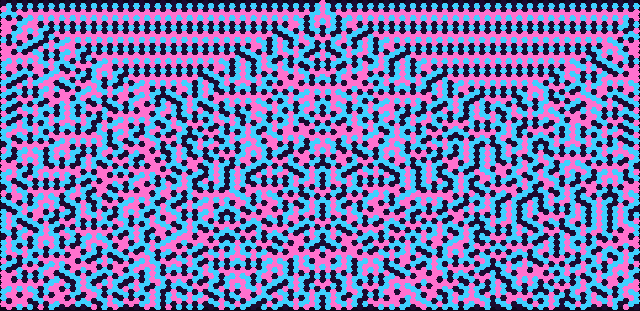
HexT3 sum 588, NW + N + NE mod 3, grows nested diamonds. Right: HexT3 sum 314
turns chaotic. Scenes docs/scenes/automata/hex-hext3-sum588.json and
hex-hext3-sum314.json, run until the bottom layer is written.Where it came from
Hexagonal grids have a long history in cellular automata. Marcel Golay used hexagonal cellular logic for image processing in 1969 (Golay 1969). Norman Packard and Stephen Wolfram’s survey of two-dimensional automata counted the rules on the hexagonal neighbourhood alongside the square ones (Packard and Wolfram 1985), and the hexagonal lattice gas of Frisch, Hasslacher and Pomeau showed why hexagons matter for physics: their symmetry is enough to recover fluid flow, where the square grid’s is not (Frisch, Hasslacher and Pomeau 1986).
The two-parent rules are Wolfram’s. In a note in A New Kind of Science, Wolfram observes that
if the cells on successive steps are arranged “like hexagons or staggered bricks”, each cell depends
on two cells instead of three; Wolfram counts 16 two-colour rules and 19,683 three-colour rules, of which
1,734 are fundamentally different (Wolfram 2002, p. 885).
HexW and HexW3 are exactly this family. Matej Kerekrety’s 2020 web tool also draws the 16 binary
rules on hexagons, along with the 256 elementary rules on squares and pentagons
(Kerekrety 2020).
The three-parent rules are a known kind of rule in a new presentation. A cell that depends on
two cells one layer back and one cell two layers back is a second-order one-dimensional automaton
on a staggered lattice. Second-order rules are standard: A New Kind of Science uses them to build
reversible rules (p. 437 and the note on p. 1017), and the Wolfram Language’s CellularAutomaton
supports staggered ranges and rules of any order
(Wolfram 2002;
Wolfram Language documentation). The 16
HexT rules of the form g(NW, NE) XOR N are exactly the reversible second-order versions of the 16
two-parent rules.
How JETCARP runs it
Notation
| Notation | Family | Rule number |
|---|---|---|
HexW 6 | two parents, 2 states | 0 to 15; the output for parents (left, right) is digit left·2 + right of the number in base 2 |
HexW3 8229 | two parents, 3 states | 0 to 19,682; digit left·3 + right in base 3 |
HexT 90 | three parents, 2 states | 0 to 255; bit NW·4 + N·2 + NE |
HexT3 n | three parents, 3 states | 0 to 327 − 1; digit NW·9 + N·3 + NE in base 3 |
HexT3 sum 588 | three parents, 3 states, totalistic | 0 to 2,186; digit NW + N + NE in base 3 |
HexT sum 6 | three parents, 2 states, totalistic | 0 to 15 |
HexT3 sym n | three parents, 3 states, symmetric | 0 to 318 − 1 |
HexT 90 is NW XOR NE, Pascal’s triangle mod 2 again; HexT 150 is the XOR of all three parents;
HexT 4 copies N straight down.
Grids
The two-parent rules run on the ordinary hexagon tiling (hex). The three-parent rules need the
flat-top hexagon tiling (hex_flat), whose rows are the half-row layers. As with the
elementary rules, each generation writes one more row or layer from a seed at the
top (top_center for one cell, top_random for a random row), with dead, live or wrapped edges, and
the run is done when the bottom is reached. These families are tied to rows of hexagons and do not
run on other tilings; the any-tiling version of the idea is the layered family.
Sheets and sweeps
jetcarp sheet --kind hexw, hexw3, hext, hext3 or hext3sum draws a contact sheet of
consecutive rules, and scripts can sweep whole sets. A first run classified all 256 HexT rules and
all 2,187 HexT3 sum rules from a single cell with JETCARP’s row descriptors, which label the rows a
rule leaves behind as uniform, periodic, shifting or aperiodic (and the aperiodic ones as nested,
regular or chaotic). For HexT that gave 44 uniform, 127 periodic, 46 shifting and 39 aperiodic
rules, three of them chaotic (153, 165 and 195). The labels are a quick heuristic, not a proof.

HexW 0 to HexW 15, from a single cell:
jetcarp sheet --kind hexw --count 16.What is new here
The two-parent rules are not new: they are Wolfram’s two-cell rules, drawn on hexagons as Wolfram describes, and Kerekrety’s tool draws the binary ones too.
The three-parent rules are built from standard ingredients, but we found no earlier source that
presents them as a family of hexagon rules, numbers all 256 binary and 327 three-state
rules in this way, adds the totalistic and symmetric subsets, or catalogues them. To our knowledge,
presenting and cataloguing the HexT and HexT3 family is new with JETCARP. The search behind this
is summarised in What is new in JETCARP.
Try it
- Quick Start: Hex rule 6 (XOR), Hex ternary 8229 (sum mod 3), Hex3 rule 90 (NW xor NE), Hex3
ternary sum 588 (sum mod 3) and Hex3 ternary sum 314. On a hexagon rule’s card,
<and>step through the rule numbers. jetcarp sheet --kind hext3sum --from 0 --count 64 --png sheet.pngdraws 64 totalistic three-parent rules.jetcarp run docs/scenes/automata/hex-hext3-sum588.json --gens 200 --png diamonds.png
References
- Wolfram 2002 (p. 885 note on two-cell neighbourhoods; p. 437 and the p. 1017 note on second-order rules); Wolfram Language: CellularAutomaton
- Kerekrety 2020
- Golay 1969; Packard and Wolfram 1985; Frisch, Hasslacher and Pomeau 1986