Rule tables
Every family on the other pages has its rule built into JETCARP. A rule table is the way to write your own: a list of transitions, each saying “a cell in this state, with these neighbours in these positions, becomes this”. Rule tables can express almost any rule with a handful of states, including rules that depend on direction, which is how classic constructions such as Codd’s automaton and Langton’s loops are usually written down.

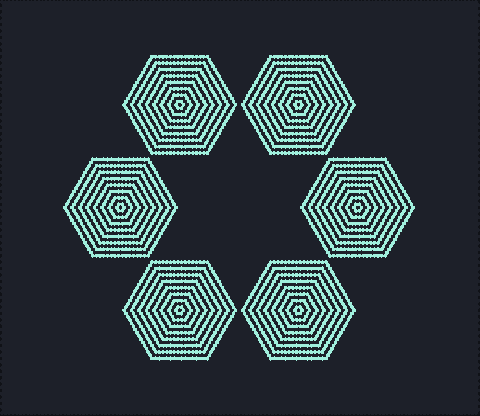
parity, in which each cell becomes the exclusive or of its
four edge neighbours, from one live cell for 63 generations. Watch the pattern copy itself: the rule is
linear, so at generation 2k the pattern is four copies of the starting cell, 2k
cells away, and each copy then replays the history so far; at generation 63, just before the next
doubling, the copies fill a diamond. Scene
docs/scenes/automata/ruletable-parity.json. Right: the same idea on hexagons, as a table
of 128 transitions written into the scene itself, 47 generations. Scene
docs/scenes/automata/ruletable-hex.json.What it is
A rule table lists transitions of the form c,n1,…,nk:new: if the cell is in state c and its
neighbours, read in a fixed order, are in states n1 to nk, its next state is new. Each position
can also be * (any state) or a set of alternatives such as 1|2|3. A symmetry setting saves
writing out every rotation of a case: rotate applies each transition to all rotations of the
neighbours, rotate_reflect also to their mirror images, and permute treats the neighbours as an
unordered collection. The first transition that matches wins; a cell that matches none keeps its
state.
Because a table can tell neighbours apart by position, it can express rules that depend on direction: a signal travelling along a wire, a gate that only lets it pass one way. That is what made tables the standard way to write constructions like Codd’s.
Where it came from
Edgar F. Codd’s PhD thesis at the University of Michigan (1965), advised by John H. Holland, and Codd’s book Cellular Automata (1968) reduced von Neumann’s 29 states to 8 while keeping computation and construction universal, with signals running along wires wrapped in a sheath (Codd 1965; Codd 1968; Wikipedia: Codd’s cellular automaton). Christopher Langton’s self-reproducing loop of 1984 was derived from Codd’s periodic emitter; it replicates with a few dozen cells but does not compute universally (Langton 1984). Rules like these are naturally written as transition tables. Tim Hutton found four flaws in Codd’s published specification, corrected them and built Codd’s complete self-replicating computer, whose tape alone is 208 million cells long (Hutton 2010).
Golly’s RuleTable format, written by Hutton, made tables a common exchange format (Golly: file formats; Golly credits), and Hutton’s Rule Table Repository collected Codd’s rule, John Devore’s 1973 variant, Langton’s loops and their successors by Byl, Chou and Reggia, and Sayama (Rule Table Repository).
How JETCARP runs it
JETCARP’s own format
JETCARP’s tables are its own JSON format; it does not read Golly’s files and uses none of Golly’s code. A table looks like this:
{
  "name": "parity-example",
  "states": 2,
  "neighborhood": "edge",
  "symmetry": "rotate",
  "arity": 4,
  "transitions": ["0,1,0,0,0:1", "1,1,1,0,0:0"]
}
arity is the number of neighbours each transition lists. A scene can carry its own tables in a
tables list, and the app can load one from a file; an automaton then uses it with the rule
Table <name>. One table is built in: Table parity, Fredkin’s replicator rule on edge neighbours
(each cell becomes the XOR of its four neighbours), generated in JETCARP from the rule’s definition.
Neighbour order on any tiling
The neighbours are read in the cell’s clockwise slot order, the same order turmites use for turning
(see How JETCARP generalises automata). On squares with edge neighbours that is
north, east, south, west. Edge neighbours are the default; touch neighbours can be chosen. Cells past a
dead edge read as 0 (or 1 with live edges). On a tiling where tiles have different numbers of
neighbours, a positional table only applies to tiles with exactly arity neighbours, and the others
keep their state; a permute table counts neighbours without regard to position.
Codd’s automaton
JETCARP v0.4.0 does not ship Codd’s rule; adding it, written from Codd’s book, is on the roadmap.
What is new here
Nothing. Rule tables are a standard tool; JETCARP’s contribution is only its own file format and running tables on any tiling’s neighbour order.
Try it
- Quick Start: Parity (von Neumann table).
jetcarp run docs/scenes/automata/ruletable-hex.json --gens 47 --png hex-parity.png, then edit the scene’s table and run it again.