The hat and the spectre
Ever since the first aperiodic sets of tiles were found in the 1960s, mathematicians had asked whether a single tile could cover the plane only in patterns that never repeat: an einstein, from the German for “one stone”. In 2023 the answer came, twice in quick succession: the hat, found by a hobbyist, and then the spectre, which does it without ever needing its mirror image. JETCARP builds exact patches of both, up to about 18 million tiles, and runs every rule on them.
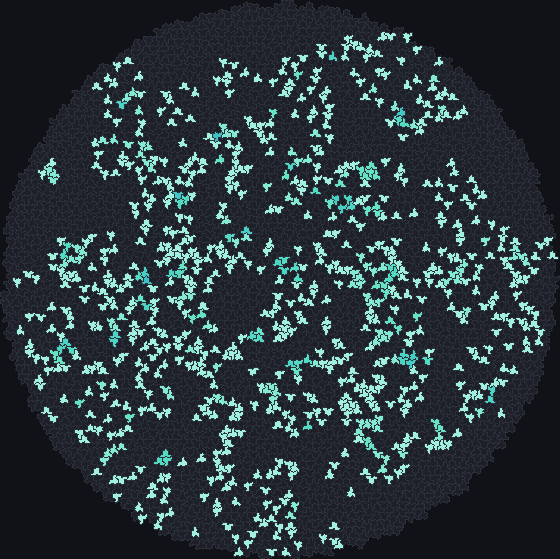
docs/scenes/tilings/hat-b2s34.json. Right: B2/S23 with edge neighbours on about 4,000
spectres, where each tile shares edges with four to seven others. Scene
docs/scenes/tilings/spectre-b2s23v.json. Both 200 generations.What it is
The hat is a polykite: eight of the kites of the Laves tiling [3.4.6.4], the tiling dual to 3.4.6.4, glued into a shape that looks a little like a hat or a shirt. Copies of it, together with some mirror-image copies, tile the plane, and every such tiling is non-periodic. The mirror-image hats are sparse; in JETCARP’s patches about one hat in eight is reflected, and the ratio of the two kinds tends to φ⁴ in large patches. The hat is one member of a continuous family of shapes, all aperiodic apart from three special cases.
The spectre comes from one of those special cases, the equilateral member of the family. Tiled without reflections it is aperiodic; changing its straight edges to curves gives the spectres, which tile only non-periodically and never use a mirror image, even when reflections are allowed. Its tilings follow a hierarchical substitution: groups of spectres form larger “supertiles” that fit together like spectres again.
For an automaton, both are neighbour graphs with no repeating structure. Each hat has 4 to 6 edge neighbours and 6 or 7 touch neighbours; each spectre 4 to 7 edge neighbours and 6 or 7 touch neighbours. The irregularity is mild, which is why rules made for hexagons often feel at home on the hat, yet movers face a different neighbourhood at every step.


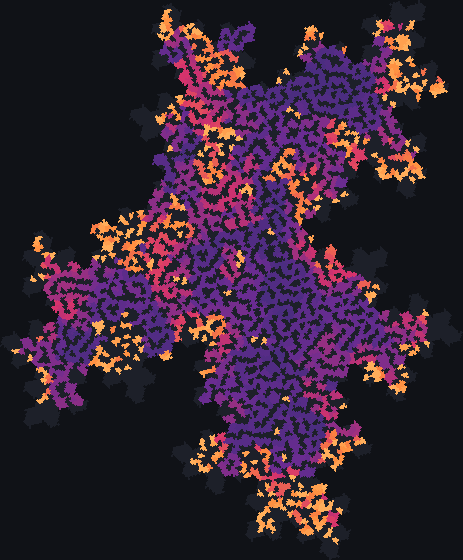
docs/scenes/automata/priority-hat-glider.json. Right: a 4-cell oscillator with period 6
in B2567/S456, found by JETCARP's soup search. On an aperiodic tiling an oscillator is tied
to the cluster of tiles it sits on. Scene docs/scenes/tilings/osc-hat-p6.json.Where it came from
Earlier aperiodic sets needed more than one tile: Robert Berger’s first used thousands of Wang tiles, Roger Penrose’s used two (Berger 1966; see Penrose tilings). Joshua Socolar and Joan Taylor gave a single hexagonal tile that is aperiodic when combined with matching rules (Socolar and Taylor 2011).
David Smith, a hobbyist in Yorkshire, England, found the hat in the autumn of 2022, working largely by hand with the help of Jaap Scherphuis’s PolyForm Puzzle Solver, and emailed Craig S. Kaplan to ask that the shape be studied with Kaplan’s software (University of Waterloo 2023). Smith, Joseph Samuel Myers, Kaplan and Chaim Goodman-Strauss posted “An aperiodic monotile” in March 2023, and it was published in Combinatorial Theory in 2024. Their proof groups hats into four metatiles with a substitution rule (Smith et al. 2023). Two months later the same four authors showed in “A chiral aperiodic monotile” that the equilateral member of the family is aperiodic without reflections, and introduced the spectres (Smith et al. 2023b). Kaplan published software for both: hatviz, which builds hat patches from the metatile substitution, and an interactive spectre app (hatviz; hat page; spectre page).
Cellular automata on the monotiles. Within weeks of the hat’s announcement, Andrew Trevorrow’s HatLife ran Life-like, Larger than Life-style, WireWorld and “Worms” rules on it (Trevorrow 2023). James Edmond found gliders on both tiles in 2026, by evolutionary search over priority tables (Edmond 2026; see Priority rules and the Spectre glider).
How JETCARP runs it
JETCARP’s hat construction is ported from Kaplan’s hatviz, and its spectre construction from Kaplan’s spectre app, both under the BSD 3-Clause licence (Kaplan granted that licence for the spectre code to JETCARP in November 2026); the notices are in JETCARP’s third-party notices file. Patches are chosen by level: for the hat, levels 3, 4 and 5 are the 500, 4,000 and 35,000 tiles nearest a fixed centre, which is a reflected hat; for the spectre, a level is a supertile level of the substitution (about 4,400 tiles at level 4 and 35,000 at level 5). Levels 7 and 8, with about 2 million and 17 to 18 million tiles, are built in exact integer coordinates, and every neighbour is found by an exact lookup. The tests check for gaps and overlaps and that the hat to reflected-hat ratio tends to φ⁴.
In a scene: "tiling": {"family": "hat", "size": {"level": 4}} (or spectre). Patch edges are dead,
and the tile shapes are fixed. For movers that need more room than any patch,
jetcarp search mover can follow a pattern on a sliding window that builds supertiles around it
as it goes; JETCARP has followed the Spectre glider pair this way for 10 million rings of tiles.
What is new here
The tiles are Smith, Myers, Kaplan and Goodman-Strauss’s, and cellular automata on them began with Trevorrow and Edmond. JETCARP adds two things that, to our knowledge, have not been done before: it runs every rule family on the hat and spectre, including families (turmites, cyclic, Greenberg–Hastings, rock-paper-scissors, Hodgepodge, forest fire) for which our search found no earlier monotile version, though we count those only as direct applications; and it computes sandpile identities and large single-source sandpiles on both monotiles, where our search found no earlier sandpile work at all (see The Abelian sandpile and What is new in JETCARP). The hat glider found by JETCARP’s search is James Edmond’s hat glider B with its states renamed, and the credit is Edmond’s; JETCARP adds only a check that it runs for a million rings of tiles on a sliding window (see Priority rules).
Try it
- Quick Start: B2/S34 on the hat, Sandpile on the Spectre, Spectre glider, Layered parity on the Spectre, JACA war on the hat tiling, and the Tiling showcase entries for both tiles.
jetcarp run docs/scenes/tilings/hat-b2s34.json --gens 200 --png hat.pngjetcarp pile --tiling spectre --grains 1e6builds a million-grain sandpile on an exact spectre patch.