Editable tile families
Some tilings in JETCARP are not fixed shapes but families: a tile whose corners you can drag and whose edges you can bend, while the tiling stays a tiling. Any triangle tiles the plane, and so does any quadrilateral; a hexagon whose edges pair up by 120-degree turns can become one of Escher’s lizards. These families, along with a few classic fixed patterns from paving and brickwork, are on this page.
lizard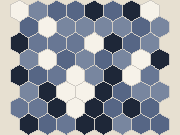
hex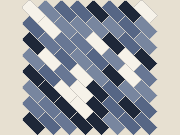
brick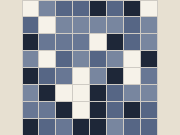
square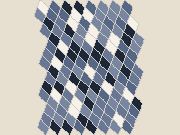
quad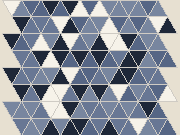
triangle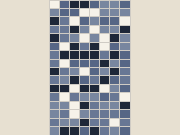
glide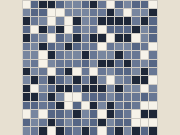
fourfold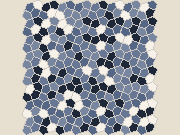
cairo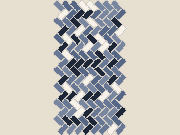
herring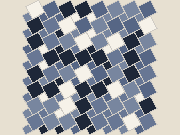
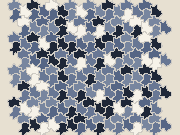
pythThe tile families of this page with their default shapes and JETCARP ids. Herringbone and the Pythagorean tiling are fixed; the others can be reshaped. Thumbnails from the tiling catalogue.
What it is
Each editable family is one prototile, a tile shape, together with rules for how its edges fit against its neighbours’. An edge can be paired with another edge by a slide (translation), by a turn about a shared corner, or by a half turn about its own midpoint, and an edge can be any curve as long as its partner follows it. The families JETCARP offers:
| Id | Family | How the edges pair | Neighbours (edge / touch) |
|---|---|---|---|
lizard | Three-fold hexagon | each edge turns 120° about a shared corner onto its partner | 6 / 6 |
hex | Hexagon | three pairs of opposite edges, each related by a slide | 6 / 6 |
brick | Brick | a hexagon with straight angles at two corners | 6 / 6 |
square | Square (parallelogram) | two pairs of opposite edges, each related by a slide | 4 / 8 |
quad | Any quadrilateral | each edge turns 180° about its own midpoint | 4 / 8 |
triangle | Any triangle | as for the quadrilateral; six triangles meet at each corner | 3 / 12 |
glide | Glide rectangle | top and bottom edges pair by a flip and a slide, so neighbouring rows are mirror images | 4 / 8 |
fourfold | Four-fold square | edges turn 90° about two opposite corners, so tiles spin in fours | 4 / 8 |
cairo | Cairo pentagon | one half-turn edge and two pairs that turn 90° | 5 / 7 |
Two fixed patterns sit beside them. Herringbone (herring) lays rectangles in two orientations and
Pythagorean squares (pyth) mixes two sizes of square; neither is edge to edge, so JETCARP measures
which tiles touch from the geometry. Herringbone has the hexagon grid’s neighbour graph; in the
Pythagorean tiling, large squares touch eight tiles and small squares four, exactly as the octagons
and squares of 4.8.8 do, and its neighbour graph is that of 4.8.8.
So, for any rule that only counts neighbours, several of these families are familiar grids in disguise: the brick, herringbone and three-fold (lizard) tilings behave exactly as hexagons, the quadrilateral, glide and four-fold tilings as squares, and the Pythagorean tiling as 4.8.8. JETCARP’s survey of neighbour graphs confirmed this for both neighbourhoods (Findings). A pattern found on one of them is a pattern of the grid it copies, and is presented as such.
The neighbour graph depends on the family, not on the exact shape, so reshaping a tile changes how the world looks but not how a rule behaves. That makes these families a way to draw: run a rule, then bend the tiles into fish or lizards.
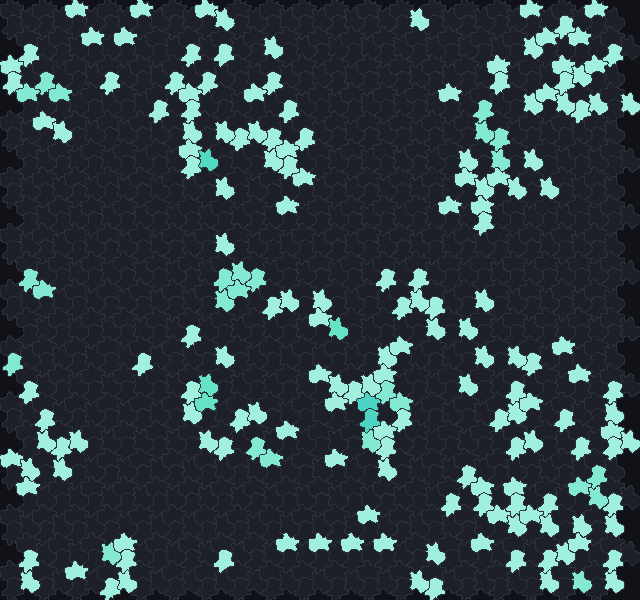
B2/S34H) in another drawing. Scene
docs/scenes/tilings/editable-lizard.json.Where it came from
Cairo pentagons. The tiling is named after its use as street paving in Cairo; R. H. Macmillan’s note of 1979 is the classic written source, and Frank Morgan went looking for surviving Cairo pavements in 2019 (Macmillan 1979; Morgan 2019). Earlier appearances include Harry Nisbet’s Grammar of Textile Design (1906), a 1909 US patent for pentagonal floor tiles by Herbert C. Moore, P. A. MacMahon’s New Mathematical Pastimes (1921), and notes by A. P. Rollett (1955) and J. A. Dunn (1971) (Nisbet 1906; Moore 1909; MacMahon 1921; Rollett 1955; Dunn 1971). Mathematically it is the dual of the snub square tiling, and its pentagon belongs to one of the families of convex pentagons that tile the plane surveyed by Doris Schattschneider (Schattschneider 1978). Carter Bays found a Life-like glider on it (Bays 2005), which Matej Kerekrety showed again as the “shrimp” (Kerekrety 2020).
Pythagorean tiling. Two sizes of square, named for the dissection proofs of Pythagoras’s theorem it carries: lay a square grid with the hypotenuse as its side over it, and the two squares are cut into pieces that make the larger one (Frederickson 1997; Nelsen 2003; Aguiló, Fiol and Fiol 2000).
Herringbone. Rectangles in two orientations; Grünbaum and Shephard list it among the isohedral tilings by quadrangles (Grünbaum and Shephard 1987).
Brick. Running bond, each course offset by half a brick. Its neighbour graph is the hexagonal one, which is why Wolfram describes two-cell rules on cells “arranged like hexagons or staggered bricks” (Wolfram 2002).
The three-fold hexagon. Tom McLean’s catalogue describes isohedral type IH7 in the same way as this family: a hexagon whose adjacent sides pair up, meeting at 120° (McLean). M. C. Escher drew lizards on a regular division of the plane in drawing no. 25 (1939), and used the same angular lizard in the lithograph Reptiles (1943) (Kersten 2018; Schattschneider 1990); we have not found a source that states drawing no. 25 is of type IH7, though the shapes agree.
How JETCARP runs it
The editable families came from JETCARP’s original prototype tiling editor and keep its edge rules.
In the app, Edit tile… lets you drag a tile’s corners and reshape its edges; every edge’s partner
follows, and JETCARP checks that tiles still interlock without gaps or overlaps. A tile can also be
pasted as JSON, and a scene records it in the tiling’s params and edges, so a reshaped world
replays exactly. Beyond these families, the periodic family takes any polygons in a repeating unit
cell, which the app’s unit-cell editor can draw; contact between them is measured from the geometry.
What is new here
Nothing. These are classical tilings and well-known tile families, presented so that any rule can run on them and the tiles can be reshaped while it runs. Results on the brick, herringbone, lizard, quadrilateral, glide, four-fold and Pythagorean tilings are results on the hexagonal, square or 4.8.8 tiling they copy.
Try it
- Quick Start: B2/S34 on Escher’s lizard tile, and the Tiling showcase entries for brick, any quadrilateral, any triangle, glide rectangle, four-fold square, Cairo pentagon, herringbone and Pythagorean squares.
- Open a lizard world in the app, start a rule, and drag the tile’s corners.